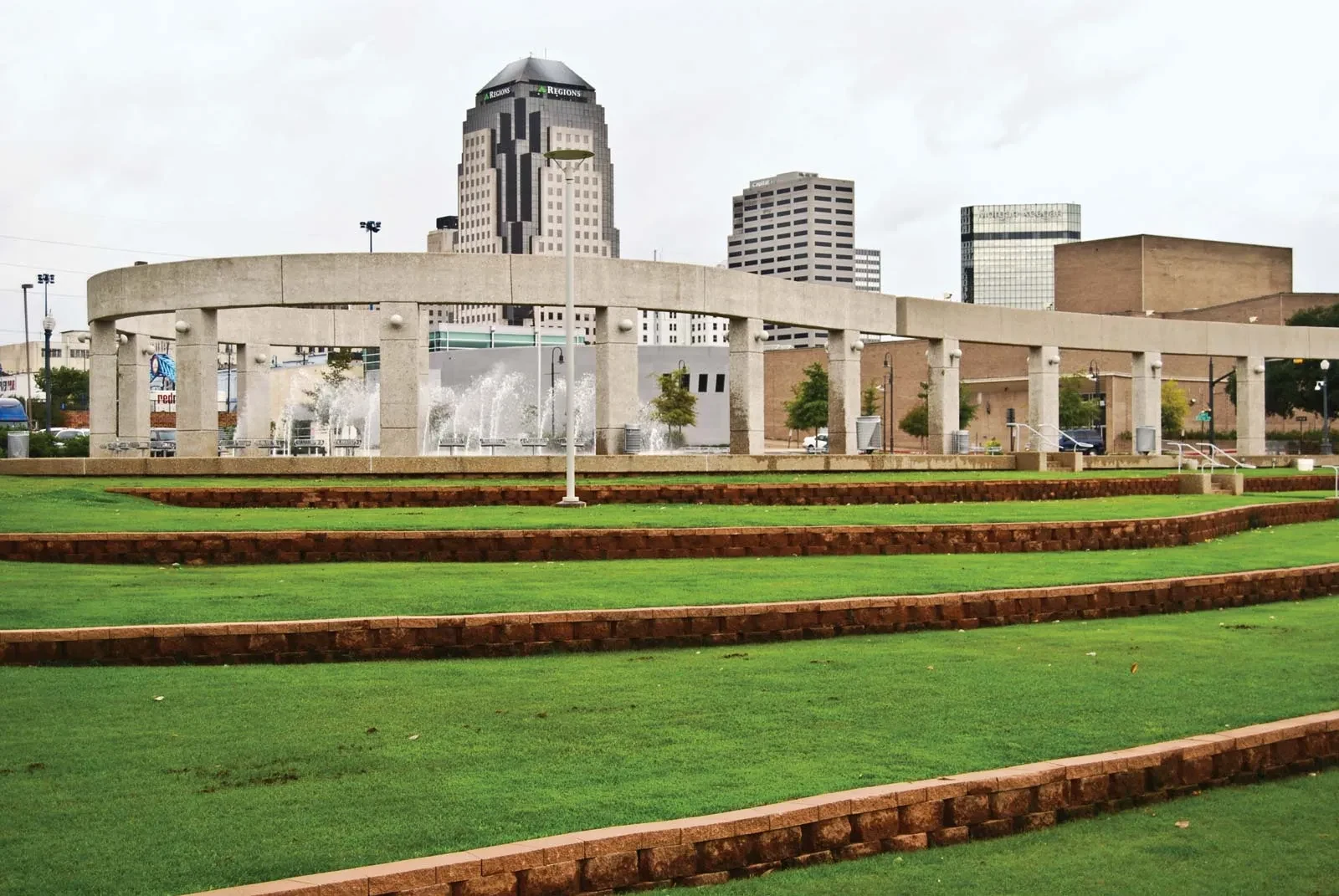
Commercial Roofing Contractors Downtown Shreveport, LA
Commercial Roofers in Downtown Shreveport
For commercial properties in Downtown Shreveport, the defensible choice between repair, restoration, and replacement starts with roof-system condition, moisture findings, drainage performance, and remaining service life. Downtown Shreveport's roofline is older than most of the rest of the metro: office towers and civic buildings from earlier decades sit alongside the riverfront casino complexes and the convention center district, and the roofs reflect it. A lot of what's up there is built-up or modified bitumen laid down before single-ply became the default, and the decision on most downtown buildings isn't new construction, it's whether to recover, restore, or finally replace.
Office Towers Built for a Different Era of Roofing
Several downtown office buildings went up or were reroofed decades ago, and a good number still carry gravel-surfaced built-up systems or modified bitumen cap sheets that have been through more UV cycles and thermal movement than the original spec accounted for. Base flashing at parapet-to-deck transitions is usually the first thing to crack, well before the field membrane itself fails outright.
Owners in these buildings are typically choosing between a recover with new cap sheet and rebuilt base flashing, or a conversion to an adhered single-ply system with tapered insulation added to correct ponding that's accumulated over years. We walk that decision with the building's actual moisture history, not a guess.
Casino Roofs on the Riverfront
The riverfront casino properties downtown run the same 24-hour occupancy pattern as their counterparts across the river in Bossier City, with gaming floors, hotel towers, and parking structures all under different roof sections and different equipment loads. We phase work in sections small enough to dry in during a single shift so the floor never has to close.
Kitchen exhaust, cooling equipment, and the dense curb clusters on a hotel roof all get flashed as part of the system, not bolted on after the membrane is down, because a leak over an occupied guest floor becomes a facilities problem within the hour.
Convention Center and Civic Buildings
The convention center district and the civic buildings around it sit in the same wind exposure as the towers next door, but public ownership changes the process: procurement timelines run longer, budgets get approved across fiscal years, and every product substitution needs documentation against the original spec. We write these scopes the same way we'd write one for a private building, then format the submittal package the way a public buyer actually needs it.
Medical District Buildings Near Downtown
The medical district buildings on the edge of downtown carry a mix of built-up roofing, modified bitumen, and newer single-ply sections added as facilities expanded piecemeal over the years. Rooftop equipment density here is high, generators, air handlers, and exhaust systems tied to patient care functions that can't tolerate an unplanned shutdown.
We schedule medical district work around infection control requirements and equipment redundancy, sequencing tear-off so at least one air handling zone stays protected at all times. That's a different conversation than a typical office reroof, and we treat it that way from the first walk-through.
- Bald patches where granule surfacing has worn through to bare asphalt on older towers
- Ponding at interior drains that hasn't cleared within a day or two of rain
- Lifted or oil-canning coping seams along masonry parapets
- Rust bleed at the corners of aging RTU curbs on office and civic buildings
- Blistering across older built-up membrane surfaces
- Staining on base flashing near parapet-to-deck transitions
Red River Humidity and Ice Events
Downtown's proximity to the Red River keeps humidity high year-round, which softens asphalt-based membranes faster than a drier inland site would see, and the Ark-La-Tex gets occasional winter ice events that stress coping, flashing, and rooftop equipment enclosures that don't normally deal with glaze ice. We check expansion and contraction points, brittle flashings, and displaced coping after any hard freeze.
Spring severe weather and remnant tropical rainfall moving up from the Gulf both test downtown's older drainage systems, many of which were designed decades before today's rooftop equipment loads existed. We trace flow from high points to discharge points rather than assuming the original design still matches what's actually up there.
A downtown roof with three or four decades of service history usually has at least one round of prior repair work layered into it, sometimes done well and sometimes done as a quick patch to get through a season. Before we recommend anything, we pull apart that repair history, test the deck where moisture is suspected, and separate what's still structurally sound from what's only holding because nobody has stressed it with a hard rain yet.
That kind of investigation takes longer than a quick visual walk, but on a building this age it's the difference between a scope that actually fixes the problem and one that gets revisited again in eighteen months.
Preventive maintenance matters more downtown than almost anywhere else in the metro, simply because the roof population skews older and the failure modes are more advanced by the time anyone calls. A standing maintenance program catches the small stuff, a lifted seam, a clogged strainer, a cracked pitch pocket, before it becomes an emergency call during a downtown event weekend.
For a downtown building manager juggling an older roof, a public-facing tenant mix, and a facility that never fully empties out, having someone track the roof's condition between inspections is often worth more than the inspection itself.
Questions Downtown Building Managers Ask Us
Is it worth recovering an older built-up roof instead of replacing it?
Often, yes, if the deck is dry and the insulation hasn't been compromised. We test moisture conditions before recommending a recover, because recovering over wet insulation just locks a problem under a new surface.
Can casino roof sections be reroofed without closing the gaming floor?
Yes. We phase tear-off into sections small enough to complete and dry in within a single access window, coordinating around security and noise limits the same way any occupied downtown building requires.
Why does civic building work take longer to get approved?
Public procurement runs on a different timeline than private ownership, with budget approval often spread across fiscal years and product substitutions needing formal documentation against the original spec.
How do you handle roof work near medical district patient care areas?
We sequence tear-off so at least one air handling zone stays fully protected at all times, and we coordinate timing with facilities staff around infection control requirements rather than working on a fixed calendar.
What's the biggest roofing risk for downtown's older office towers?
Base flashing failure at parapet transitions, usually well before the field membrane itself gives out. We check those transitions first on any older downtown building.