PVC Roof Systems in Shreveport, LA
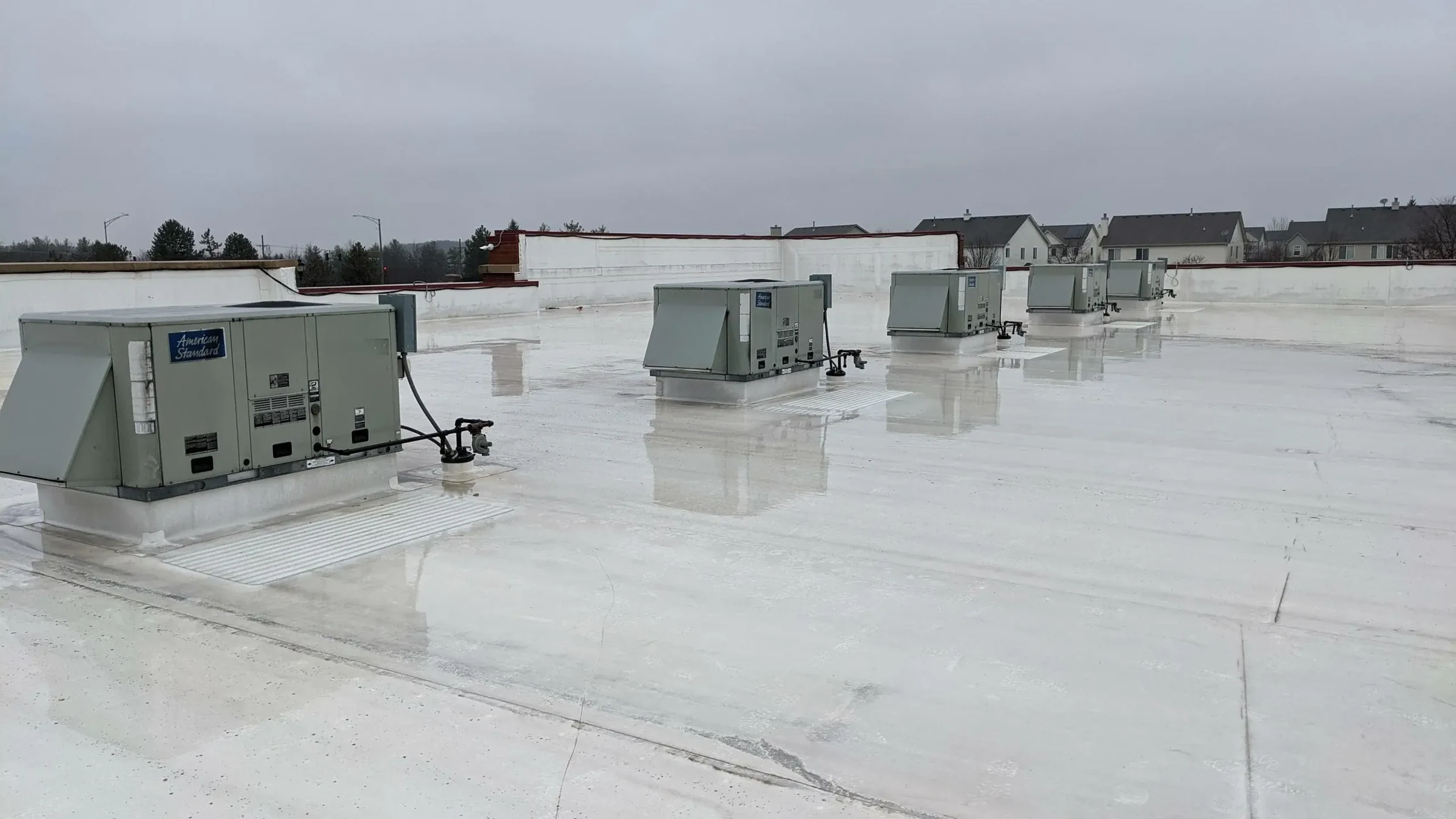
PVC Membrane for Grease-Heavy Casino and Restaurant Roofs
PVC single-ply is the membrane we reach for when grease and chemical exposure are part of the roof's daily environment, and that describes a specific slice of the Shreveport-Bossier market well: riverboat casino back-of-house kitchen exhaust, standalone restaurant rooftops, and any building venting commercial kitchen equipment across the deck. TPO and EPDM both degrade faster under sustained grease contact than PVC does, and that difference shows up over years of service life, well beyond anything a spec sheet alone would tell you.
Why Grease Exposure Changes the Membrane Decision
Kitchen exhaust fans push grease-laden air across whatever roof surface sits downwind of them, and over years that residue accumulates on the membrane surface and works into seams if the membrane wasn't built to resist it. On a casino property with multiple kitchen operations feeding rooftop exhaust, that exposure is constant and concentrated in specific zones of the roof, not evenly spread across the whole deck.
We map exhaust discharge points before recommending membrane type, because a building with one small kitchen exhaust vent doesn't need whole-roof PVC, but a property with several commercial kitchens venting across a shared back-of-house roof usually does.
Hot-Air Welded Seams and Chemical Resistance
PVC seams weld with hot air similarly to TPO, but the compound itself resists grease, oils, and certain cleaning chemicals better over time. That matters directly at seam locations, which are the failure point when a membrane starts breaking down under chemical exposure. We probe every PVC seam the same way we probe TPO, but we pay particular attention to seams that fall directly under an exhaust discharge path.
Grease film on a membrane surface also affects how new work ties into old work during future repairs, so we clean exposed areas before doing any tie-in weld rather than welding over residue and hoping it holds.
Standalone Restaurant Roofs Around Shreveport-Bossier
Standalone restaurant buildings usually have a small footprint with a concentrated exhaust load relative to roof area, which makes the grease-exposure problem more intense per square foot than a large kitchen on a big commercial property. We see this on quick-service and full-service restaurant roofs scattered along the retail corridors on both sides of the Red River, and PVC's chemical resistance earns its cost on these smaller, harder-worked roofs even though the total membrane area is modest.
- Exhaust discharge mapping before recommending membrane type or zone coverage
- Grease-resistant PVC membrane specified at concentrated exposure zones
- Seam cleaning and prep before any tie-in weld near exhaust paths
- Fan curb and exhaust penetration flashing detailed individually
- Post-install seam probe focused on high-exposure zones first
Wind and Hail Performance
PVC handles the same spring storm wind and hail exposure this region sees regularly about as well as TPO does at comparable thickness, so we're not trading storm performance to get the chemical resistance. Fastening pattern still gets engineered to the building's wind zone rather than a generic minimum, and that's true whether the membrane is PVC, TPO, or EPDM.
Hail resistance follows membrane thickness more than membrane chemistry, so a thin PVC sheet isn't automatically tougher against impact than a thicker TPO sheet would be. We'll spec thickness based on the same traffic and exposure analysis regardless of which chemistry the roof needs.
Budgeting for a Higher Line-Item Membrane
PVC typically costs more than TPO or EPDM per square foot, and we don't pretend otherwise. On a roof without concentrated grease or chemical exposure, that premium doesn't buy anything a cheaper membrane wouldn't already deliver. On a casino back-of-house roof or a restaurant with heavy exhaust load, it buys real service life that a TPO membrane in the same location would burn through faster.
We'll show the reasoning zone by zone if a property has both exposed and unexposed roof areas, because it's common to spec PVC only where the exhaust load actually lands and a standard membrane everywhere else.
Coordinating With Hood Cleaning Contractors
Commercial kitchen exhaust hoods on casino and restaurant properties get cleaned on a recurring schedule by a separate contractor, and that cleaning cycle interacts directly with the roof around the fan curb. We coordinate with an FM's hood cleaning vendor when we're doing any work near an exhaust fan, because a curb flashing detail that gets disturbed during a hood cleaning service call and then never reported back to facilities is exactly how a small leak starts without anyone connecting it to the right cause.
If your hood cleaning contractor is working near the roof penetration, we'd rather be looped into that schedule than find out after the fact that a curb seal got bumped loose.
Questions Facilities Managers Ask About PVC Roofing
Do we need PVC across the whole roof, or just near the kitchen exhaust?
Usually just the exposed zones. We map exhaust discharge before recommending coverage, and most properties don't need whole-roof PVC unless exhaust sources are spread across the deck.
How much longer does PVC last under grease exposure compared to TPO?
The gap depends on exhaust volume and cleaning frequency, but PVC consistently outperforms TPO and EPDM under sustained grease contact, which is the entire reason it costs more.
Does PVC handle Shreveport's hail and wind as well as TPO?
At comparable thickness, yes. Storm performance tracks membrane thickness and fastening pattern more than membrane chemistry.
Can existing grease-damaged TPO be repaired instead of replaced with PVC?
Sometimes, if the damage is localized and the membrane is otherwise sound. We inspect before recommending a full membrane swap over a targeted repair.
What maintenance does a PVC roof need near kitchen exhaust?
Periodic cleaning of grease film near discharge points, in addition to standard seam and flashing inspection twice a year.